

The “GMW 15634 Determination of Volatile and Semi-Volatile Organic Compounds from Vehicle Interior Materials” standard, developed by General Motors Worldwide (GMW), is an engineering standard used to determine volatile organic compounds (VOCs) and semi-volatile organic compounds (SVOCs) emitted from vehicle interior materials. This standard is particularly important for evaluating the emission behavior of materials used in automotive cabins.
Automotive interior materials can release small amounts of chemicals into the cabin air. These emissions may result from:
The GMW 15634 standard provides a standardized method for identifying and semi-quantitating these emissions. The aim is to help manufacturers control indoor air quality and prevent excessive concentrations of undesirable substances.
The GMW 15634 standard focuses primarily on two emission categories:
The standard for material approval specifically identifies restricted compounds such as BTEX and styrene: concentrations of 1 ppm or higher require measurement under Method A.
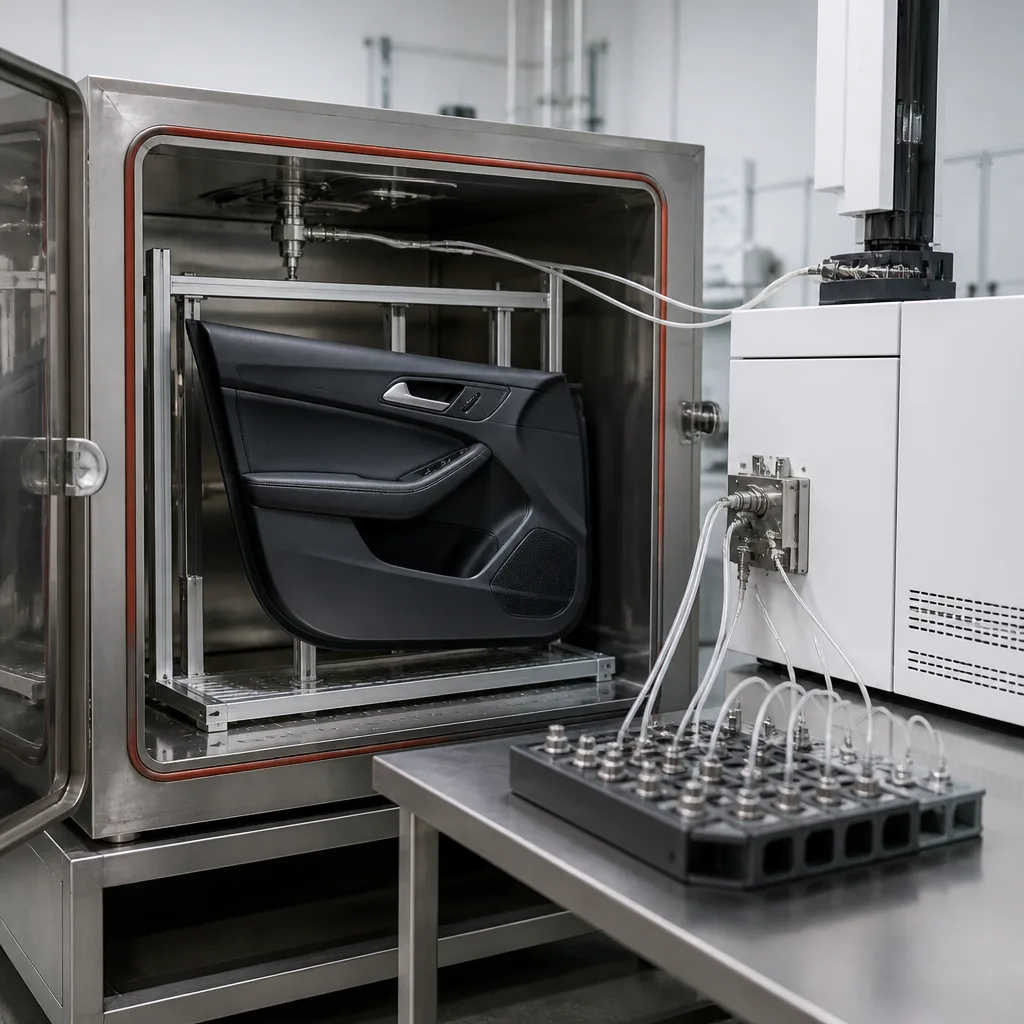
The tests utilize the GMW 15634 standard thermal desorption-gas chromatography/mass selective detection (TD-GC/MSD). The basic principle is as follows: automotive material, controlled heating, released organic compounds, collection, thermal desorption, GC/MS analysis, identification, and semi-quantification. The material sample is heated under controlled conditions to release volatile and semi-volatile substances. The released compounds are collected and then fed into a gas chromatograph/mass spectrometer for analysis. For VOC analysis, samples are heated to approximately 90 degrees, and for SVOC analysis to 120 degrees, followed by thermal desorption and GC/MS analysis.
The GMW 15634 standard includes two analytical approaches:
A typical GMW 15634 laboratory setup includes the following:
The use of GC/MS allows for the identification of individual organic compounds from their characteristic retention times and mass spectra.
In general, the testing procedure follows these steps:
The actual dimensions, mass, heating conditions, calibration, and reporting requirements of the sample are specified in the GMW 15634 standard.
This standard uses reference substances for semi-quantitative assessment. For example, toluene is defined as a reference for VOC assessment and n-hexadecane is defined as a reference for SVOC assessment. This allows the laboratory to consistently express results and compare emissions from different materials.
The GMW 15634 standard is important because vehicle occupants spend a significant amount of time in the passenger compartment. Therefore, interior materials should not release excessive amounts of undesirable organic compounds. This standard helps to:
The GMW 15634 standard is part of a broader family of automotive interior emissions test methods. Laboratories often list this standard alongside others such as VDA 278, GMW 15635, GMW 3205, and GMW 3235.
The GMW 15634 standard is closely related to the VDA 278 standard approach because it uses thermal desorption and GC/MS techniques to characterize organic emissions from non-metallic automotive materials. However, they should not be considered automatically interchangeable. The GMW 15634 standard includes General Motors-specific requirements, including definitions, restricted substances, and assessment procedures.
The GMW 15634 standard is applicable to many types of interior vehicle materials, including:
Testing laboratories currently list the GMW 15634 standard for materials such as plastics, elastomers, films, textiles, leather, coated textiles, composites, and foams.
In conclusion, the GMW 15634 standard allows laboratories to identify and semi-quantify VOC and SVOC emissions using GC/MS analysis following thermal desorption.
The main value of this standard is not only to measure the total amount of emissions, but also to identify individual compounds and control restricted substances that may affect the quality of the vehicle interior environment. For suppliers of plastics, foams, textiles, leather, coatings, adhesives and other interior materials, compliance with the GMW 15634 standard requirements is a crucial part of the material approval process.
For many years, our organization, with its competent and experienced staff, has been understanding the needs of its clients, providing the advanced testing services they require, and assisting them in the establishment, implementation, and improvement of management systems. Within this framework, we also provide testing services in accordance with the GMW 15634 standard.
To get an appointment, to get more detailed information or to request an evaluation, you can ask us to fill in our form and reach you.

